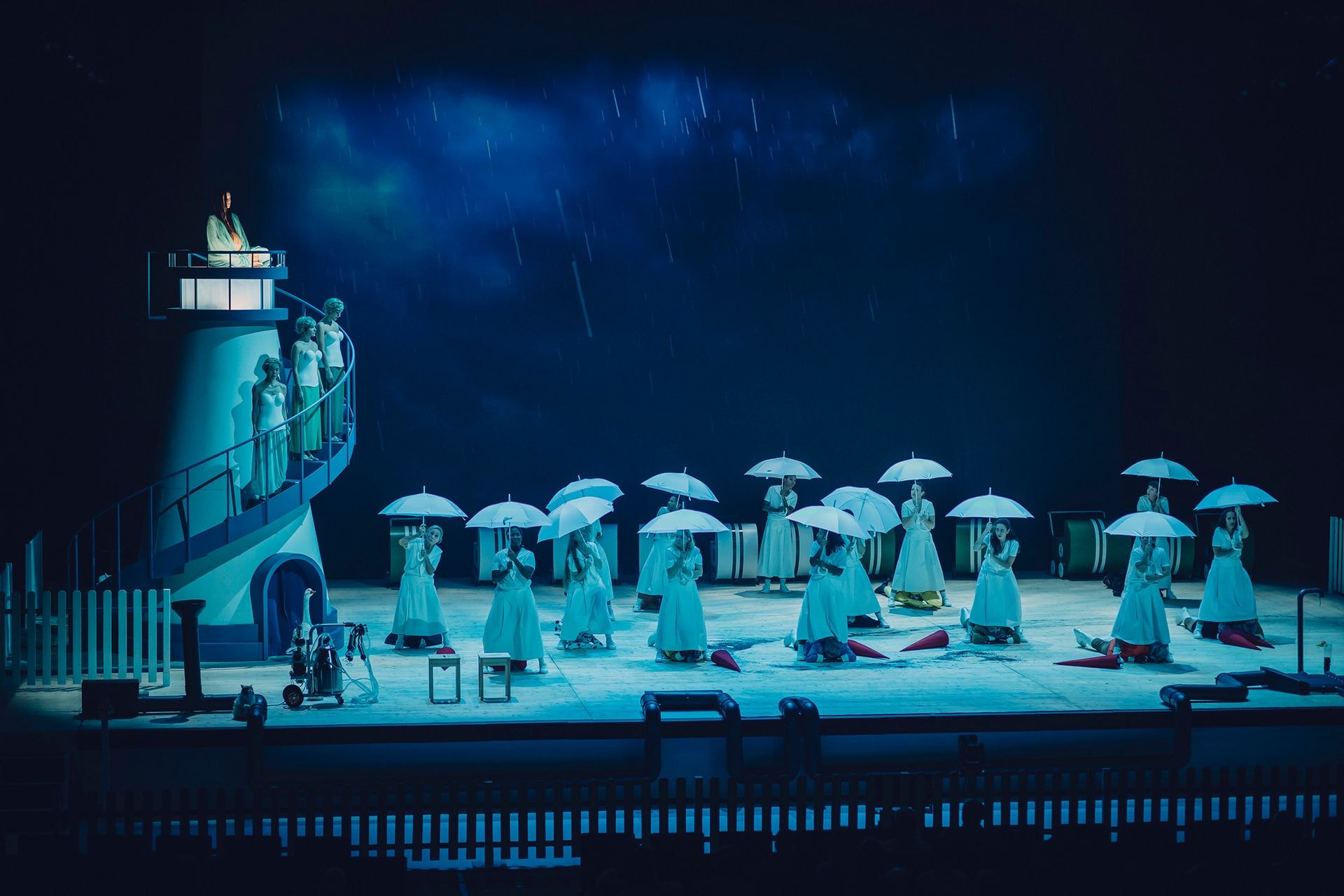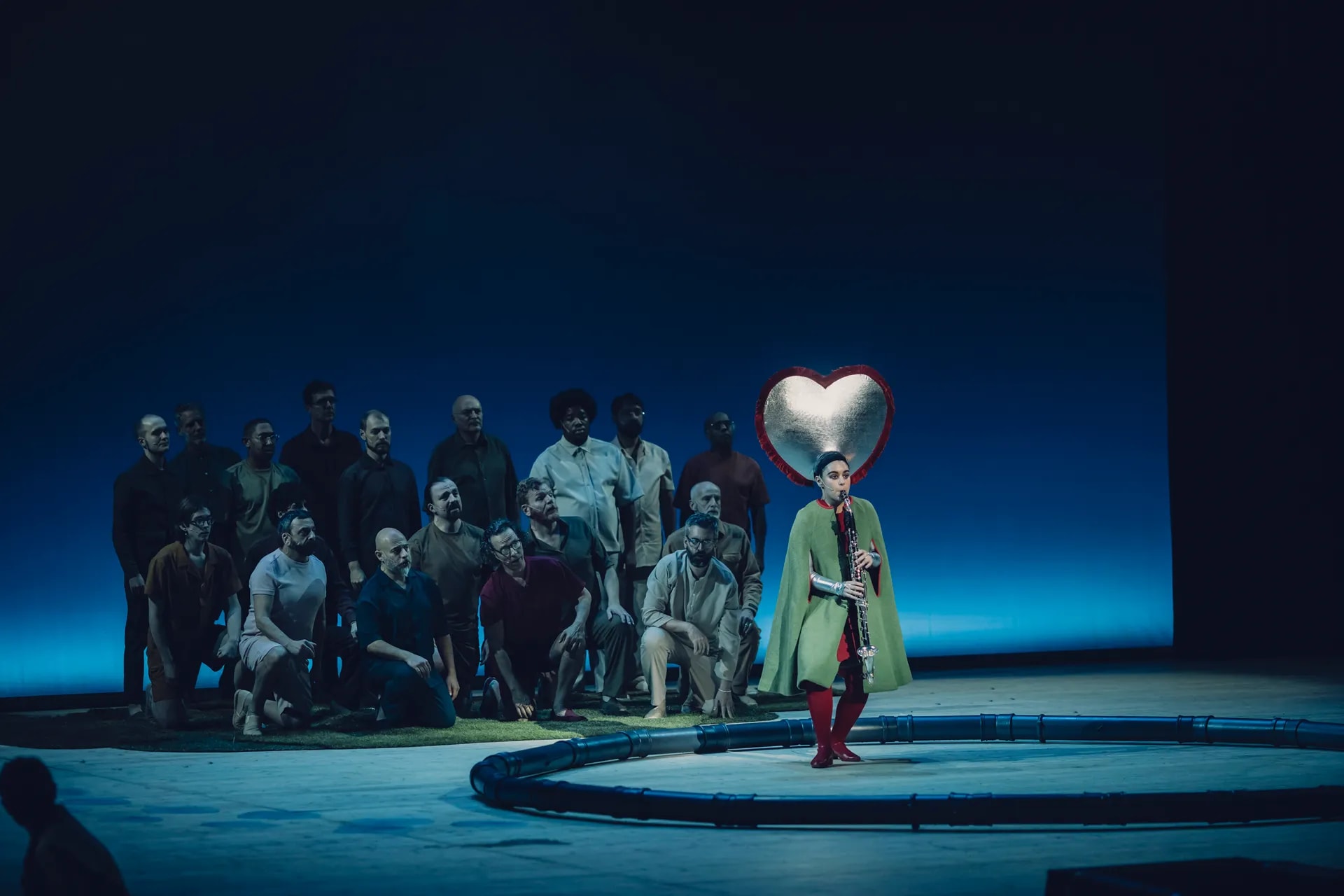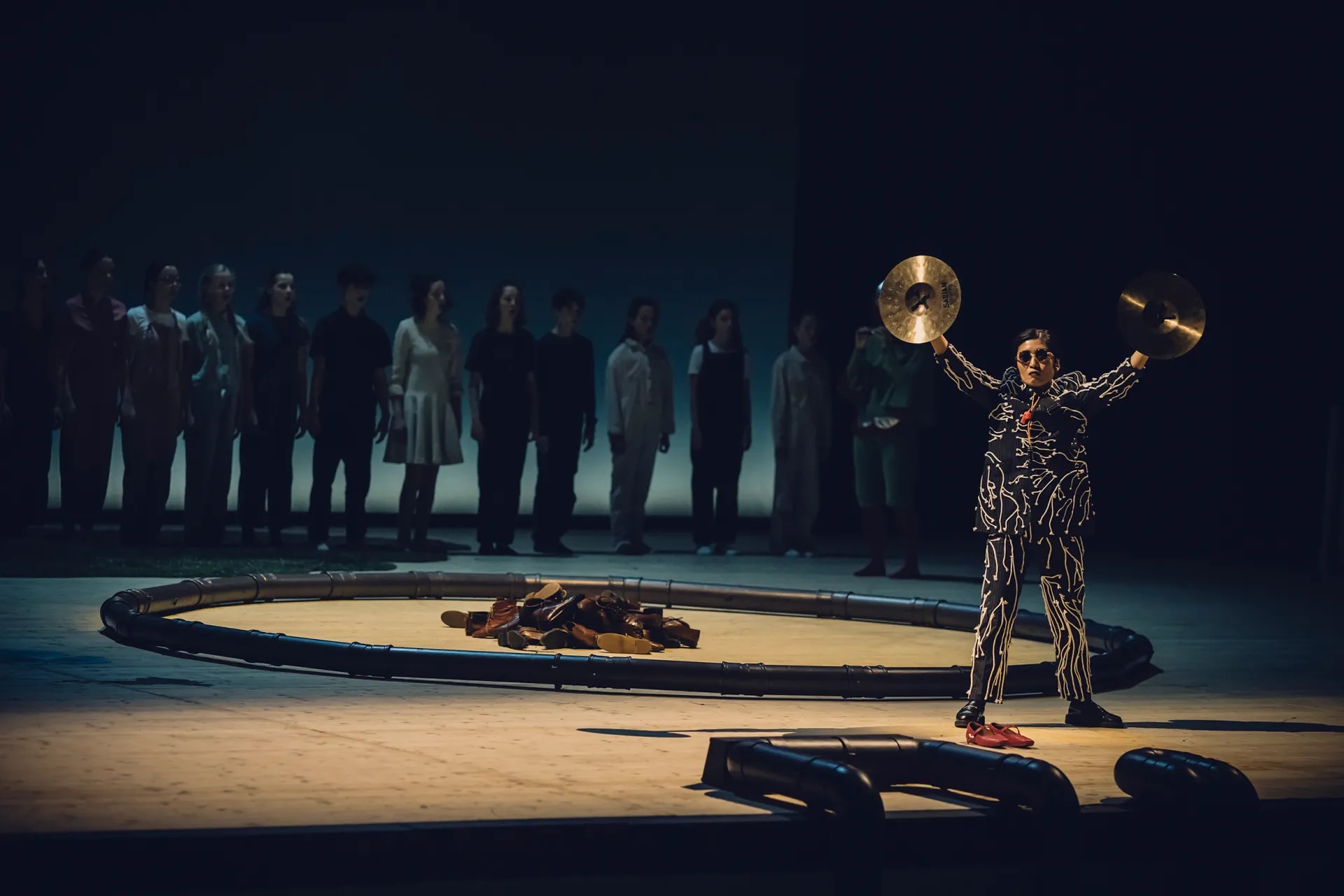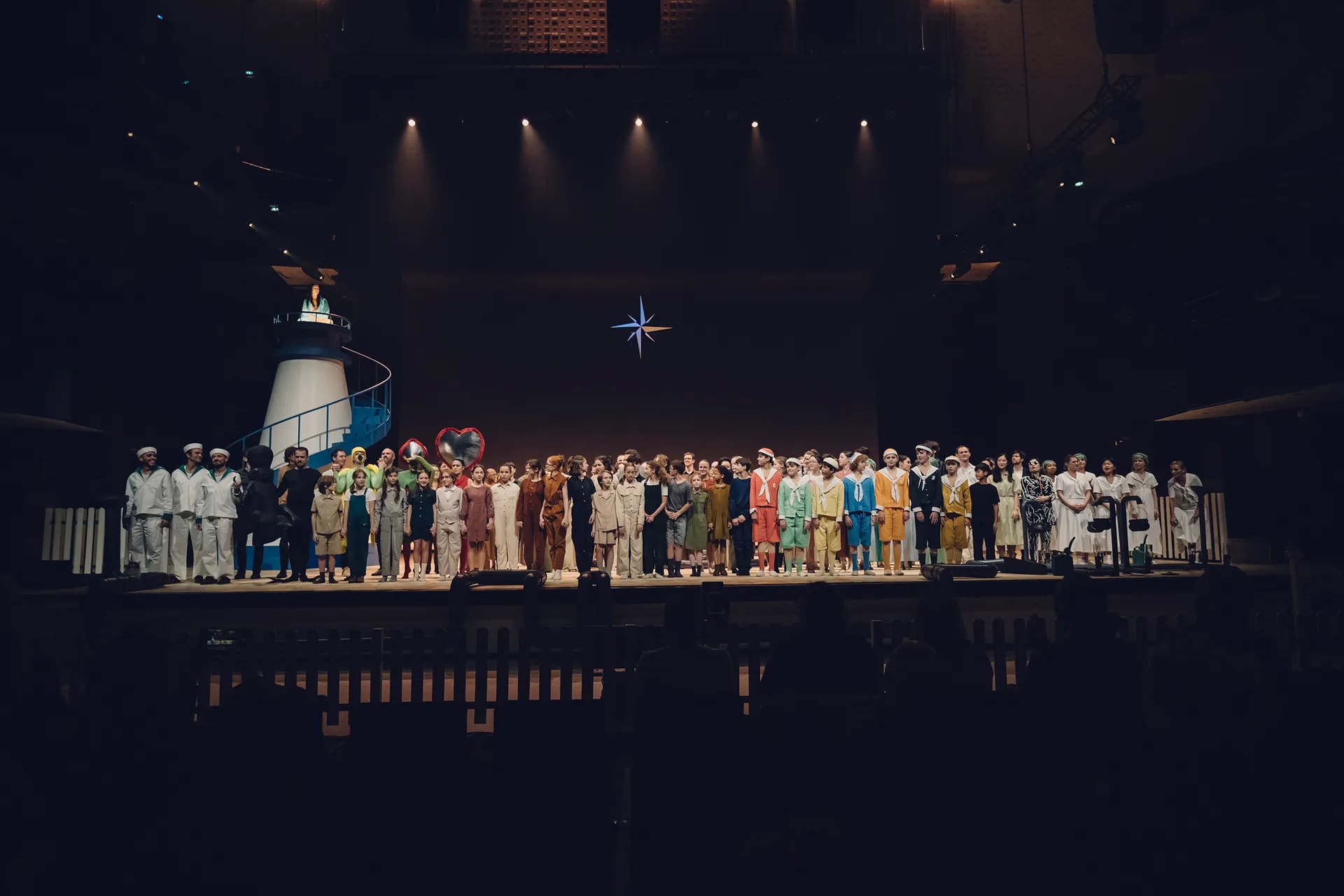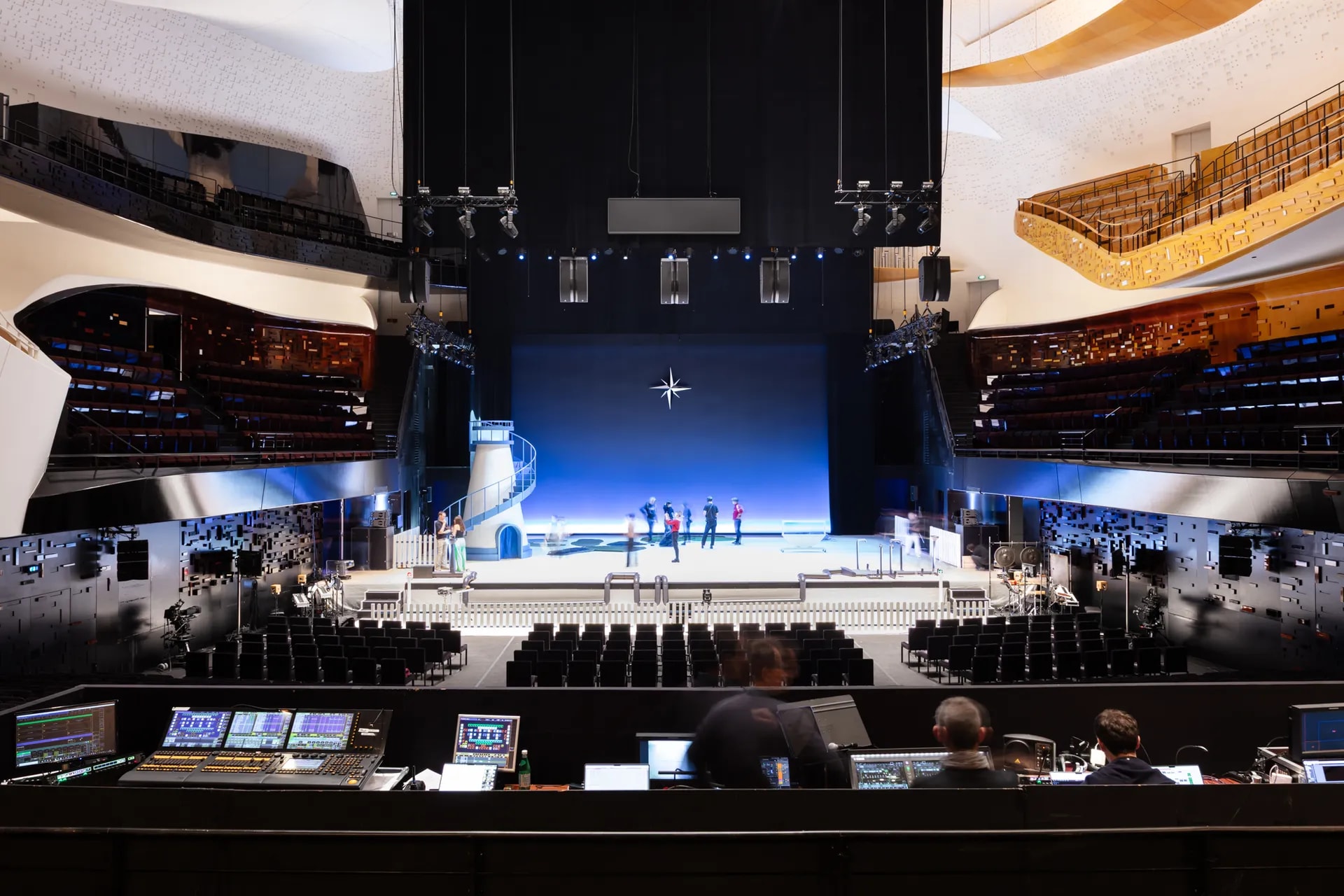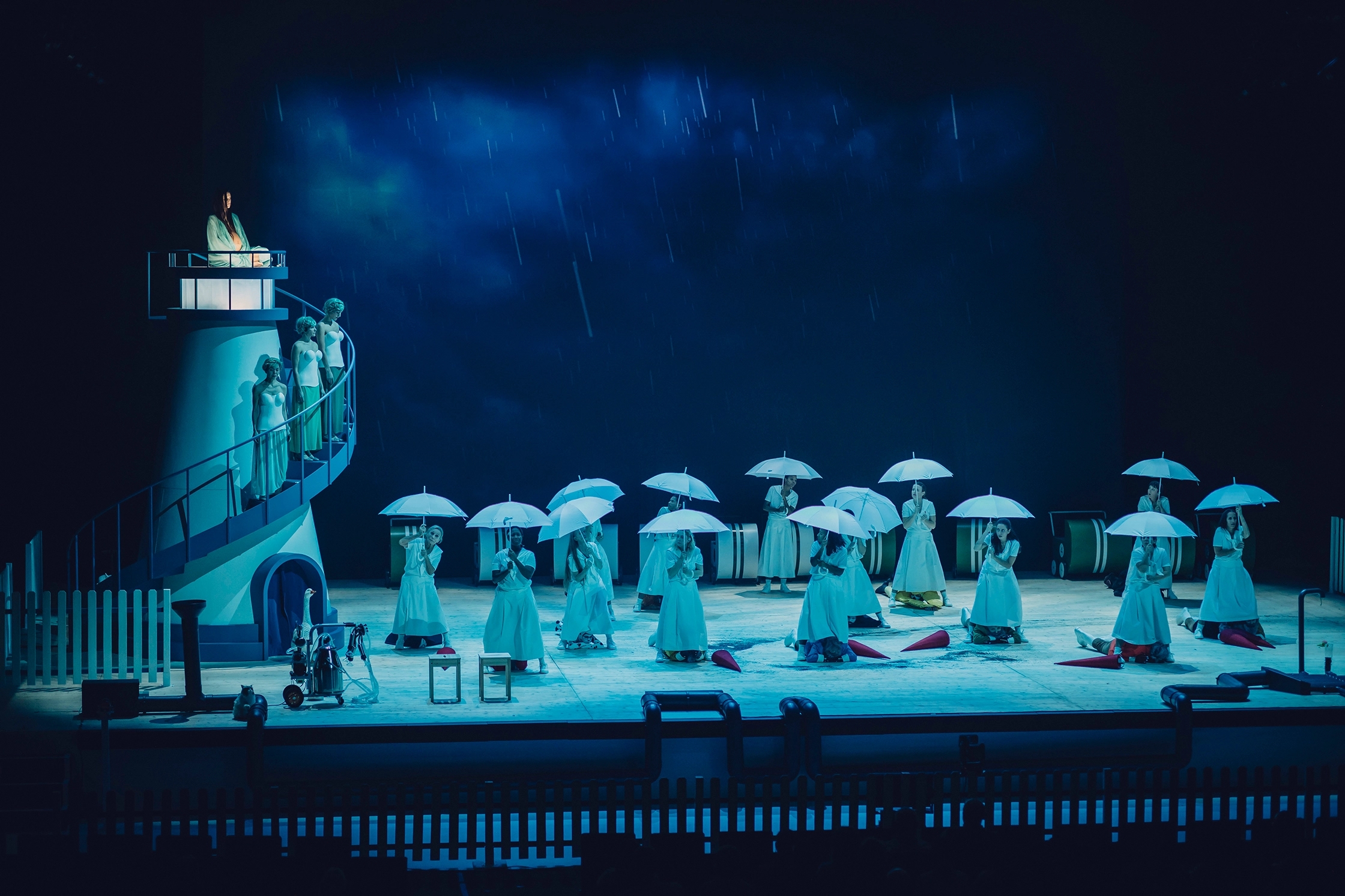
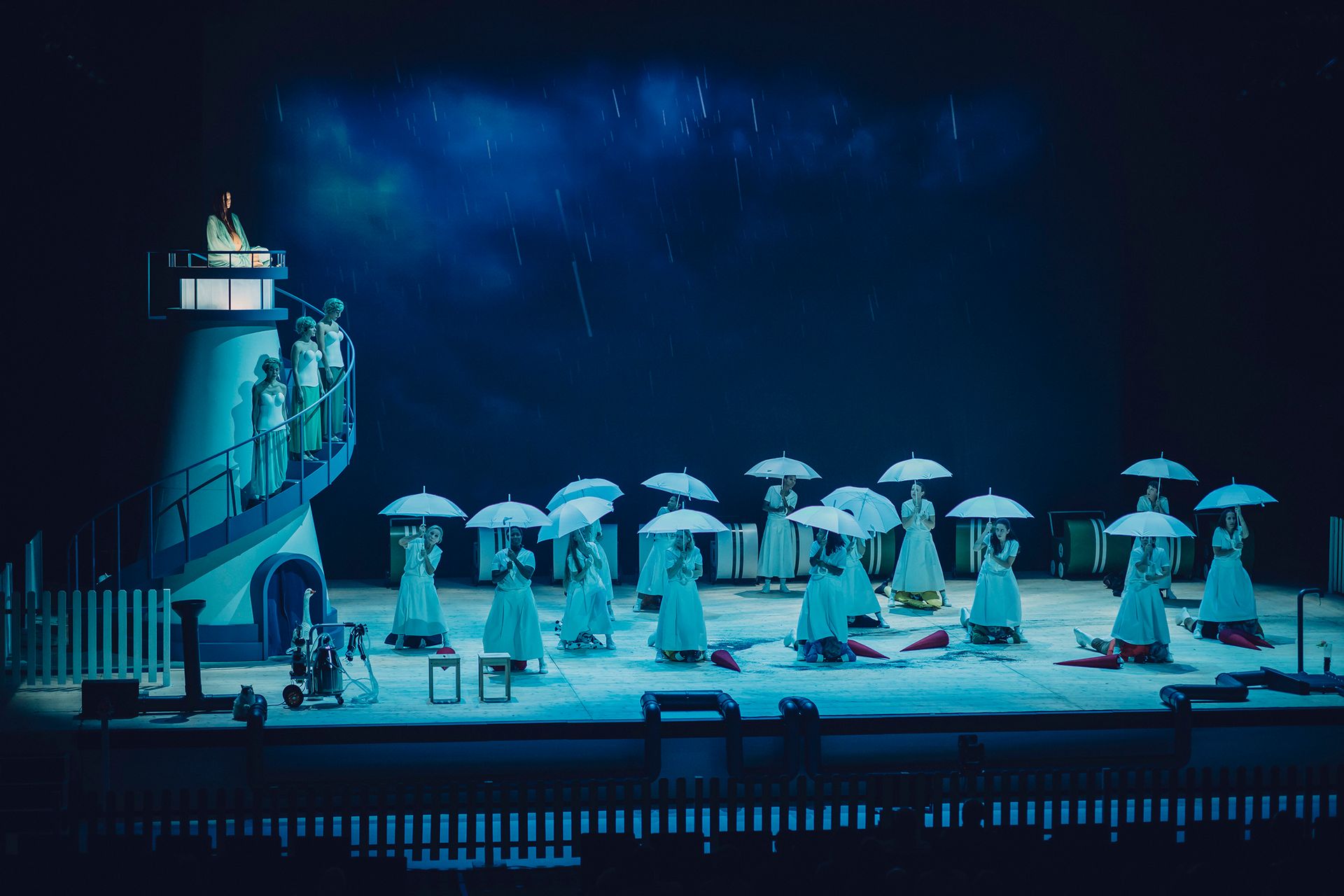
At the Philharmonie de Paris, the 2025 edition of the Festival d’Automne and the contemporary music ensemble Le Balcon, under the artistic direction of co-founder Florent Derex, unveiled one of the most ambitious staged music projects in contemporary opera: Montag aus Licht by Karlheinz Stockhausen. This production, part of Stockhausen’s monumental seven-part opera cycle Licht, was brought to life in a full staging produced by Le Balcon.
For Le Balcon, a company renowned for its pioneering work in contemporary and mixed music, Montag is not merely an opera, it is a technical and artistic summit. Unlike traditional opera with an orchestra in the pit and singers on stage, Montag aus Licht unfolds as a constellation of forces: six choirs, nearly 250 choristers, detailed choreography, intricate processions, and continuous spatial movement written directly into the score.
Florent Derex notes:
We have more than 200 singers who are costumed, staged, and all on wireless microphones, with very precise choreography, and Stockhausen gives spatial indications in the score that we must recreate as faithfully as possible.
Stockhausen, one of the first composers to integrate live electronics and spatialisation directly into his writing, envisioned the sound engineer as a central performer. His scores specify not only musical gestures but trajectories, placements, and sound movements that form part of the dramaturgy.
For Florent Derex, who is both producer and sound engineer, the project represents a unique convergence of artistic vision and technical ingenuity. As he explains,
“Stockhausen placed the sound engineer at the very heart of his work. He wrote this opera over the course of thirty years, sitting at the console himself.
To honour this vision in 2025 requires a system capable of precision, power, and narrative subtlety, a system that could translate the complexity of Stockhausen’s late-20th-century imagination into today’s architectural and acoustic reality.
A Hybrid System Powered by an Agnostic Engine
The Philharmonie’s iconic hall, designed by Jean Nouvel, offers a magnificent yet demanding environment for immersive sound. Its floating balconies, cloud-like canopies, and generous 2.5-second natural reverberation make traditional spatial approaches nearly impossible. Deploying a dense, three-dimensional WFS system was out of the question; the geometry alone would require an unmanageable number of loudspeakers.
Instead, Florent Derex designed a hybrid system where HOLOPHONIX becomes the core engine: a central, adaptive processor capable of unifying multiple loudspeaker families, formats, and spatial approaches into a coherent whole.
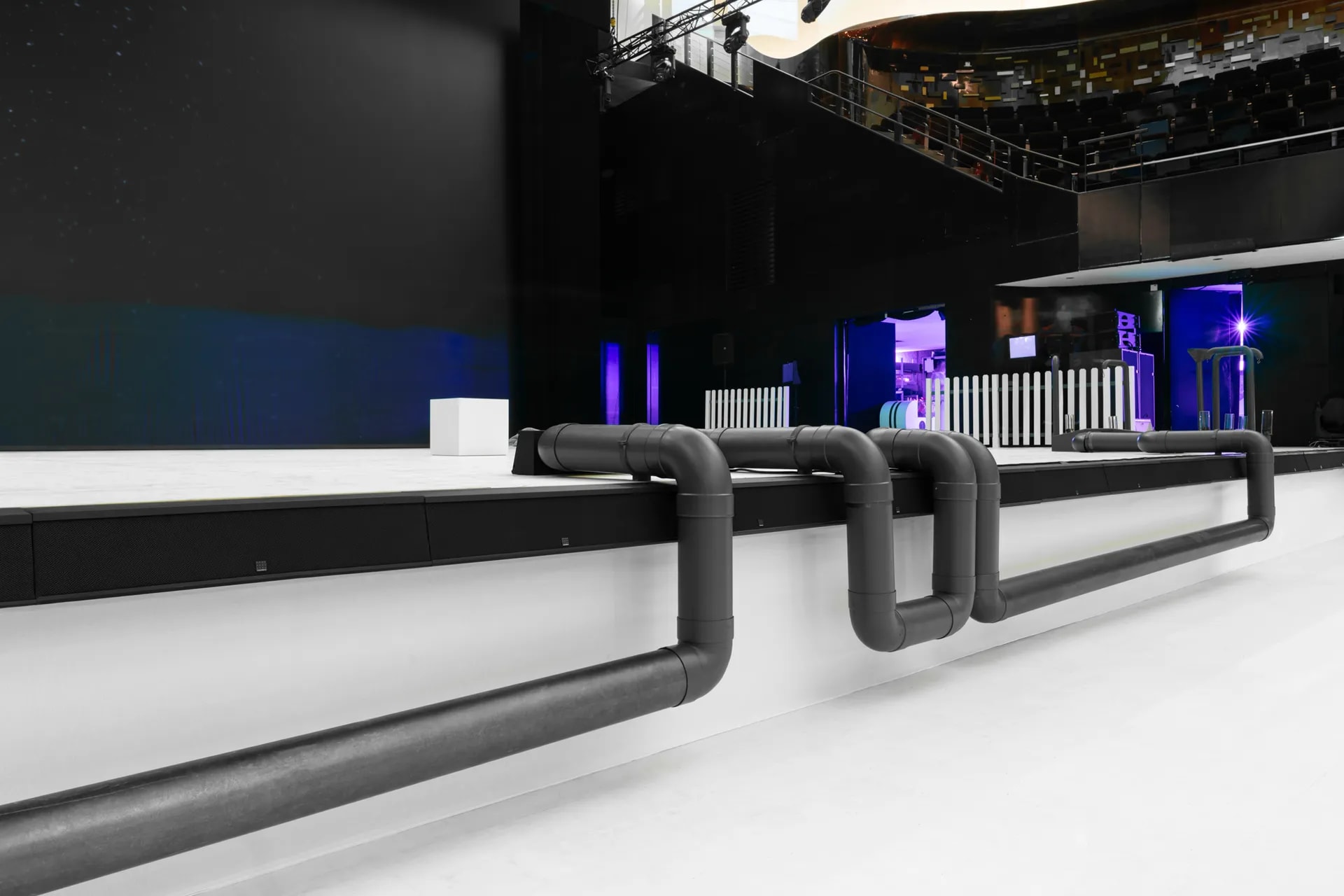
At the heart of the setup is a front-fill sound ramp developed by Amadeus and deployed over nearly 22 meters. This large-format sound bar is built around the Amadeus SR 790 model, featuring a 5.25-inch diaphragm transducer, two 5.25-inch passive radiators, and a 1.75-inch dome tweeter, all configured in a coaxial arrangement.
The lower level is a beautiful Amadeus ramp using their SR790 system. It runs the entire length of the stage front and integrates perfectly with the scenography. In our case, it is built into tubular elements that are part of the set design. This gives us nearly 22 meters of continuous coverage,
says Florent Derex.
Above this front-fill ramp, driven in Wave Field Synthesis (WFS) by the HOLOPHONIX processor, a second tier of L-Acoustics L2D line-source systems provides full coverage of the hall’s unique architecture, while circular clusters of L-Acoustics Kiva II diffuse the electronic trajectories and choir movements, creating a multi-layered spatial fabric that adapts to the demands of the score.
The audio architecture of Montag aus Licht is both sophisticated and streamlined. At its core is HOLOPHONIX, an agnostic spatialisation engine, capable of managing multiple loudspeaker families within a single architecture. It drives all spatial decisions, transitions, and object movements, from the precise placement of 200 microphoned singers to the highly choreographed trajectories of the electronic sources via the KNN buses and the two frontal planes driven in WFS.
HOLOPHONIX is the core of the reactor, everything passes through it,
notes Florent Derex .
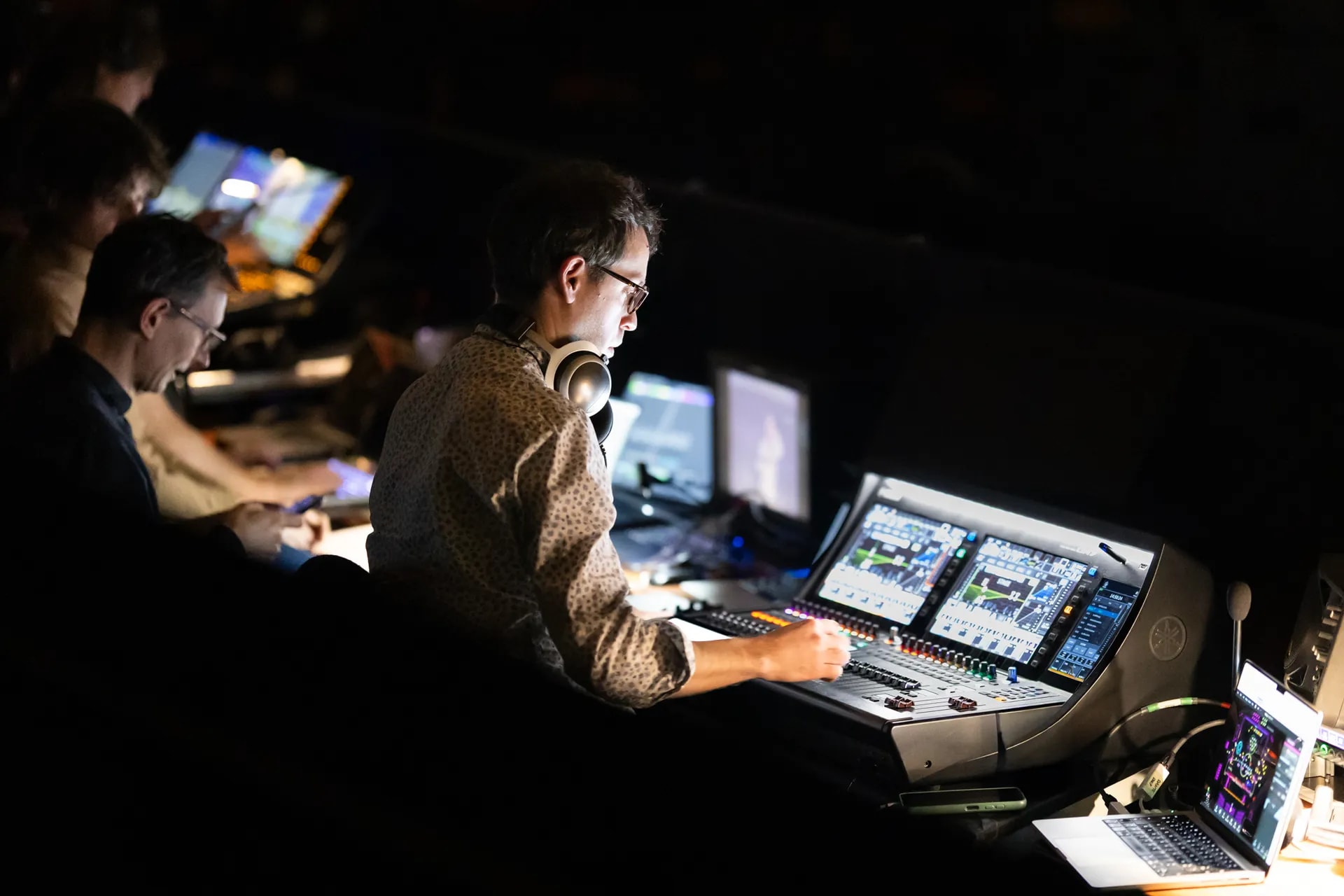
Mixing is handled through a Yamaha DM7 console, while pre-amplification and digital conversion rely on AX32 and DAD systems. Microphones include Schoeps compact CCM series for instrumentalists, clipped directly to their instruments, and 6061 microphones for the singers.
Preparation begins long before the system is physically deployed. Florent Derex programs every source, movement, and bus directly into HOLOPHONIX, translating the highly detailed spatial instructions from Stockhausen’s score. During rehearsals, he follows the performance physically and in real time, integrating his observations into the system. On site, the workflow is highly efficient: deployment of all sources and spatialisation takes just three to four days.
Once the system is in place, HOLOPHONIX enables precise deployment of all sound sources:
Within HOLOPHONIX, I position sources exactly where they need to be. For the first time, I am also using positional control directly from the Yamaha DM7 console. Previously, we had to find workarounds to route sources through buses and adjust panning from the console. Now, we can move coordinates in X and Y directly from the Yamaha console, it’s extremely effective.
For electronic sources and complex bus routing, HOLOPHONIX interacts seamlessly with OSC-controlled Max objects, enabling remote control of source movements across multiple spatial buses.
This integration ensures that sound is not just amplification but an intrinsic part of the performance, translating Stockhausen’s late-20th-century spatial vision into a fully immersive experience.
Unlike traditional opera houses, the Philharmonie offers only a few days of on-site adaptation. HOLOPHONIX enables Derex and his team to transition seamlessly from rehearsal observation to full-scale deployment, translating the composer’s spatial notations with fidelity and fluidity.
Everything has to be done in three or four days. There are a lot of people involved but it works, and we’re very happy,
explains Florent Derex .
The result is a performance where sound does not accompany the staging, it is the staging. Spatial trajectories become choreography; loudspeaker arrays become part of the dramaturgy; and Stockhausen’s vision, conceived in the late 1980s with tools far more limited than today’s, is finally given the spatial breadth it imagined.
The Licht cycle will continue its journey next year at the Deutsche Oper Berlin, marking the culmination of the seven-year cycle with Mittwoch aus Licht undertaken by Le Balcon and its partners. The Philharmonie, having accompanied each chapter, will also host the reprise.
For HOLOPHONIX, this project stands as a testament to what is possible when technology becomes an instrument of artistic intention, when spatial sound is not decoration but narrative architecture.
Florent Derex sees a broader change happening across the classical world:
Many musical directors now fully understand that loudspeakers are part of our musical and artistic history. And thanks to technologies like HOLOPHONIX, it’s much easier to integrate audio systems beautifully into a scenography.
As Le Balcon prepares future projects, including a major 2028 production reimagining Pierre Henry’s iconic Tenth Symphony of Beethoven at theThéâtre de Châtelet, HOLOPHONIX remains at the centre of a growing practice: a new way of staging sound, where the loudspeaker becomes a dramaturgical tool and spatialisation becomes performance.